Paid and Organic Marketing. It's a longstanding debate — and in 2025, the conversation is more relevant than ever. For many marketers, especially small to mid-sized businesses, these two channels remain the most complex to navigate effectively.
Whether you’re investing in one strategy or combining both, the key is knowing how each approach fits into your broader marketing goals. In this guide, we’ll break down the strengths, limitations, and best practices of Paid and Organic Marketing strategies, and how a hybrid approach could drive better ROI and long-term brand growth.
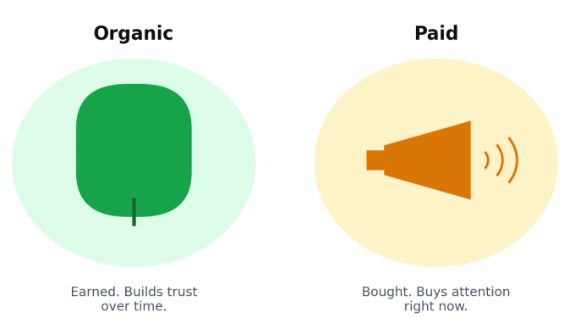
Organic Marketing is the process of naturally attracting your target audience without paid promotion. It's about building relationships through valuable, relevant content across platforms like your website, blog, email, and social media.
🚀 Stat to Know: According to recent data from HubSpot, businesses that focus on SEO as part of their organic strategy see 12x more leads than those relying on paid ads alone.
Paid Marketing involves paying to display your content to a targeted audience. In 2025, platforms like Google Ads, Meta Ads, and TikTok Ads Manager offer advanced audience segmentation, dynamic retargeting, and AI-powered recommendations.
📈 Example: Instagram’s 2025 update uses machine learning to match paid ads with user behavior across Reels and Stories — making retargeting even more seamless.
AspectOrganic MarketingPaid MarketingCostTime investment, minimal spendDirect financial investmentSpeedSlower, builds over timeFast traffic, quick feedbackLongevityEvergreen potentialShort-term unless consistently fundedTrust FactorHigh (user-initiated engagement)Varies (depends on ad quality)AnalyticsSEO + social engagementIn-depth ad metrics and attribution
The most successful brands now blend organic and paid efforts. Here's how to make it work:
Use buyer personas, engagement data, and search trends to schedule content when your audience is most active. For example, X (formerly Twitter) now supports AI-based content scheduling aligned with peak engagement windows.
Don't hit "Boost" on every post. Promote content that already performs well organically or supports a specific campaign. Use Reels, carousels, and interactive polls to extend your reach.
Use platforms like Databox, HubSpot, or GA4 to automate performance tracking across your blog, website, and ad campaigns. AI-powered dashboards simplify optimization based on live metrics.
TermDefinitionLeadA user who has shown interest by interacting with your businessEvergreen ContentTimeless, always-relevant material (common in organic strategies)SEOSearch Engine Optimization — helps rank your content in SERPsSERPSearch Engine Results PagePPCPay-Per-Click — ads you pay for when clickedConversionWhen a user completes a goal, like a purchase or form submissionCTRClick-Through Rate — the % of people who click your ad/linkBounce RateThe % of users who leave your site without engaging furtherCost-Per-Click (CPC)How much you pay for each click on a paid adMeta TagsHTML snippets that help search engines understand your pageMeta DescriptionShort text that appears under your page title in GoogleRobot Meta TagsDirect search engine bots to index or follow links appropriately
Use SEO plugins like Rank Math, All in One SEO, or Yoast (WordPress) to manage your meta tags without touching a line of code.
A typical small-to-medium business might start with $600–$1,000/month, optimizing through A/B testing. Remember, PPC runs on a bidding model — focus on high-intent keywords with solid Quality Scores to maximize your ROI.
In a digital world driven by algorithm shifts, privacy laws, and evolving customer behavior, relying on just one approach isn’t enough. Organic marketing builds the brand trust you need for the long haul, while paid marketing delivers the reach and speed necessary to scale.
By integrating both strategies, you empower your marketing team with flexibility, authenticity, and performance-driven decision-making.
Ready to future-proof your marketing strategy? Start by analyzing your audience behavior, defining your campaign goals, and committing to both consistent organic content and smart paid promotion.
-----------------------------------------------
Paid and Organic… It’s nothing new. However, of all marketing channels, according to our clients, these are the most cryptic and overwhelming channels to master. What does your journey look like with Paid and Organic marketing channels?
Maybe you’re tried one and are wondering if the other is more fruitful. In this blog, we’ll explore both approaches and the different forms they can come in. Each has their virtues and vices, and sometimes using a combination of both can cultivate a more consistent return on your advertising investment.
By the end of the article, I hope you’ve got a clearer perspective on the marketing technique that suits your individual needs, and perhaps learnt something new to bring to your marketing team.
Organic Marketing believes in creating natural connections between themselves and their clients. They operate across various different social media and website channels, using unpaid content forms to promote their brand. Feed updates across Organic Marketing’s social media platforms don’t include boosted posts. Rather, they tailor their content to SEO trends and relevant hashtags to reach their target audience. LinkedIn cites that SEO, when partnered with Organic Marketing as a primary method of meeting consumer pain points, can generate ‘1000% more traffic than organic social media’ marketing functioning alone.
Organic Marketing does not focus on a short term return on investment – it looks toward the bigger picture. Often organic marketing seeks to create long-term loyalty between customers and brands. It can encourage a community wherein customers can share their experience with like-minded individuals and bring them across to your business by recommendation. Organic Marketing has the power to spread naturally because posts shared by your business may then be re-shared by your followers, thus connecting with a whole new community of people.
Organic Marketing uses various formats to connect with potential leads – this can include email campaigns, blogs, social media posts, videos and informative/educational/entertaining content. Essentially, Organic Marketing is not shoving a sales campaign in a customer’s face. Organic Marketing is centred around providing a solution to a customer’s problem in a way that feels empathetic, natural and timely. Organic Marketing allows you to engage with your customers in a supportive way throughout the duration of the sales journey that makes them feel understood, so they’ll form a bond with your brand and want to revisit.
Organic Marketing does come with its own set of challenges. Namely, getting your posts to the top of the algorithm consistently. Whilst SEO remedies this obstacle significantly, it can be difficult to have your posts remain in a visible space when they aren’t benefiting from paid boosting.
For example, Hootsuite finds that ‘the average organic reach for a Facebook post is about 5.5% of your follower count.‘ Another challenge of using Organic Marketing is firming up the connection between your website and social media channels – without paid intervention, it can be difficult to close the conversion of getting a client to click through to your website.
This is where retargeting campaigns come in – it can be a great hybrid approach to use your marketing budget for boosting your website back onto the suggested pages of leads who have since clicked off your site. Promotional emails can also be a form of re-targeting once a purchase has been made, or indeed as advertising material on their own.
Paid marketing can sometimes suffer a negative rep. With the amount of advertising we consume across social media and searching online, our palates for advertising have become far more gourmet if you will. Insincerity and pushiness in sales campaigns read as a deterrent for potential leads.
Supplementing this, post-pandemic, the convenience of online shopping has been earmarked by a significant uptick in paid social media advertising. As such, responding to the desirability of convenience can benefit your business by providing solutions that are instantaneous and accessible from the comfort of your buyer’s home. Often, people tend to picture paid marketing as one of those blown-up, waving creatures parked out the front of car washes that scream about the cheap deal available. We’re going to debunk that myth and show you how paid marketing can be honed to influence your advertising reach effectively.
Paid marketing can come in similar forms to that of Organic Marketing. Meaning you could use social media posts, blogs and website content, collaboration posts, videos, events and commercials as a means of advertising your business. Paid marketing is able to be analysed through various different means, such as social media analytics tools and conversion rates as a result of click-throughs, lead generation and post impressions. A successful example of paid marketing comes through the latest upgrades to Instagram – utilising website and search history analytics, customer interests are often transmitted by algorithm across your socials and searching platforms. As a result, potential leads may encounter paid advertising tailored to products or pain points of note for them that pop up into their Instagram feed without necessarily coming across as an advertisement straight away. This could be, for example, collaboration posts that featured paid product placement.
Lead: A generated lead means that a customer has interacted with a touchpoint – whether an email, a message via social media, an advertisement or a form – and has opened up communication with your business.
Evergreen content: Pertaining more to organic marketing strategies, evergreen content is defined as material that responds directly to your audience’s needs, and is always relevant to them.
SEO (Search Engine Optimisation): Used particularly for organic marketing, search engine optimisation prioritises your business at the top of search engine results pages to reach your target audience. It uses keywords, key phrases in searches, geographic location, customer searching behavioural patterns and purchase history to boost your content as the most relevant.
PPC: Pay-Per-Click advertising, meaning advertisements that are boosted by financial backing.
Conversions: Conversions apply to both paid and organic marketing. At a simple level, a conversion is defined as a customer-fulfilling interaction with your business. This could be making a payment, completing a review, filling out a form or responding to an email.
Daily Budget: An amount of money – with a budget cap – that you are planning to spend on a marketing campaign per day. This may vary depending on the days you need to factor in boosting posts or posts that you selectively invest more in because they have a higher chance of reaching your target audience.
Campaigns: Campaigns are a series of ads that seek to generate – in the case of paid marketing – financial investment in your product or service from potential customers. Campaigns can come in different forms, such as sales campaigns ( these target monetary return for the business as a primary goal), email campaigns (these are delivered to the inbox of potential clients or returning customers to offer deals or promotions and encourage brand loyalty), or social media campaigns (utilising social media platforms as a means of promoting offers, connecting with your clients and establishing a community).
Bounce Rate: The numerical amount of users who are clicking away from your website and not interacting with any of the pages
Click-Through-Rate: This could be linked to the percentage of visitors who click on to your website using the links provided in your social media posts or accounts. It could also be a percentage of users who visit your website based upon an online advertisement built upon their search, geographical location and other customer profile factors. Conversion Rate: The calculated percentage of the website or social media visitors who are performing an interaction with your business.
Cost-per-Click: This is the investment you make into search engines or websites for the right to advertise your business across their product.
Dynamic Advertisement Targeting: Similar to SEO, this feature allows you to promote your product or service to the right audience based on data surrounding their searches and individual needs.
Keyword: Keywords can be used in partnership with SEO for organic marketing campaigns to reach your target audience based upon keywords, phrases or questions that commonly pop up in their searches.
Meta tags: Meta tags are used for SEO purposes in organic marketing strategies. They help to boost your website/content reach, and target your relevant audience. Meta tags are developed as HTML code that are then added into the <head> section of your content pages. Thus, meta tags are only visible in the behind-the-scenes elements of your SEO process, but they’re an essential ingredient to an effective SEO strategy.
Meta description tags: When you search for something using a search engine, it usually displays the title of the webpage and then a brief couple of sentences – also known as a slug – that can be either generated from the page automatically or developed specifically by the content creator. If you write the meta description yourself, you can include keywords and phrases that match the content up with common queries, searches and questions asked by search engine users.
Robot meta tags: These are for the search engine itself. They essentially help search engines program where your content will appear on a page of results – the technical terms are ‘indexed’ or ‘followed.’ Think of indexing as ordering or organising and following as a link that works and leads you to the relevant webpage.
Whether you’re using paid or organic marketing (or a combination of both), you need to consider the when, how, what, where and why of everything you post/upload to your website. If you post multiple times a day, the likelihood that your post is going to get traction is lower because you aren’t allowing your audience the time to digest the content you’ve put out. Also, look into your buyer personas – what are the lifestyle habits of your potential and current customers? When do they use their social media? What applications do they prefer? What kind of posts resonate the most, and what kind of numbers are you getting? Consider what’s happening in your industry when you post – what’s trending? What time of day do your posts get the most interaction, leads convert the most frequently?
That boost button is magical. However, when you’re working with a marketing budget, you need to ensure that you invest intelligently. There’s no point in boosting posts that have no further incentive for your audience/don’t have the potential to gain traction. If you’re encouraging a product introduction to your audience, why not make use of the social media variables such as Reels, Stories, Highlights and Links to string out the promotion and keep your audience engaged. Timing of boosted posts matters too, if you boost a post whilst the majority of your target audience is asleep, then you defeat the purpose of investing in paid marketing.
In fact, we’re doing it right now! That’s because we’ve used research across our social platforms to determine what kinds of content are most relevant for our followers. Additionally, staying ahead of the game allows our team to focus on other tasks whilst our social media platforms are pre-prepared. The only other focus then becomes monitoring and noting what our audience makes of the content so that we can pivot accordingly for the months to follow.
As good as you may be at designing, writing, producing and recording the content you’re planning to use – the reality is that computers are just unequivocally the experts at providing numerical analysis, based upon large volumes of data. You can use subscription applications such as Databox to help measure post impressions and social media reach – additionally, you can link Databox to your website so that it counts conversions from posts to website clicks.
Keep to approximately 60 characters and try not to use keywords over and over again; this comes off as ungenuine for website users, and it also makes your content look like it has been written by a robot.
Stick to around 140 and 160 characters.
If you’re unsure of how to code yourself, you can seek help outwardly from an experienced digital marketing agency! However, if you’d like to get into the content-publishing cycle yourself, you can enlist the help of plugins – similar to Chrome extensions – that help do the work for you. Hubspot cites examples such as All In One SEO and Rank Math as helpful SEO tools that can act as an editor and reviewer for any meta tags you write.
This depends on a number of factors related to your marketing strategy. Particularly, how much money your business is going to invest into an entire Google Ads campaign – you may decide to spend $600 a month and divide this amongst different pieces of content. Additionally, remember with PPC that the system works in a bidding process. Keywords are awarded a quality score based upon investment from a business, and then Google ranks them accordingly. Thus, if you find yourself with a higher quality score for a particular keyword, you can plan your budget based upon this. Cost-per-click also helps determine the expense of a monthly Google Ads budget – if you’re working with pricey keywords, the less is more approach may be infinitely more important than simply throwing money at heaps of vaguely related words.
Depending on your marketing budget as a business, you may be able to shift and adapt your strategy depending on what works through experimentation. Using a combination of paid and organic marketing gives you the flexibility to share your individual voice as a company, but maintain the benefits of fast conversions and financial return. A hybrid approach favours your brand by feeling authentic whilst achieving consistent income and setting your business up for the future. Automating your approach to marketing with the help of digital applications can solidify your approach by allowing your marketing efforts to be productive rather than time-consuming.